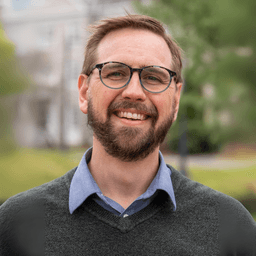
Dr. J. Cody Nielsen (he/him/his) is an educator, consultant, and speaker who helps campuses and organizations navigate complexity with both clarity and care. As Executive Director of Convergence Strategies and Assistant Professor of Higher Education Leadership at Western Michigan University, he has worked with more than 200 institutions across North America, guiding leaders, students, and communities through issues of belonging, identity, and organizational culture.
Dr. Nielsen is recognized for his thoughtful analysis and human-centered approach, bringing depth and accessibility to conversations that many institutions struggle to have. His work spans higher education leadership, dialogue across difference, and the intersections of religion, race, gender, and politics, helping communities move beyond avoidance to more honest engagement. From addressing tensions on campus to reimagining the mission of higher education, he challenges institutions to foster environments that center human dignity, cultural agility, and shared vision.
In his role as a professor, he also supports the growth of the profession and the next generation of leaders in higher education, ensuring that future practitioners are prepared to meet the evolving challenges of the field. A frequent presenter at national and international conferences, Dr. Nielsen connects timely issues with long-term purpose, curating each engagement to the realities of the community in front of him. With a style that is both grounded and forward-looking, he invites audiences to think critically, act with compassion, and imagine education as a pathway to belonging and collective transformation.
He earned his Ph.D. in Higher Education Administration at Iowa State University and holds Master’s degrees in Mental Health Counseling from the University of Northern Iowa and in Divinity from Wesley Theological Seminary in Washington, D.C.
Reclaiming the Mission of Higher Education: Our Past, our Present, and Our Vision for the Shared Future Education
With the current moment of political and social upheaval occurring in the United States (and beyond) there has never been a more important moment for higher education to consider the importance of reclaiming or core mission and vision. This keynote talk is specifically tailored to the campus setting and will invite participants to consider who "we" are and what our role on campus looks like.
Rehumanizing the Field of Higher Education: A pathway from the market model to the marketplace of ideas
Education settings have moved from being a place wherein individuals believe themselves to be "finding themselves" and claiming their identities to a business model in which the manufacturing of degrees is the most important aspect of the academy. This talk specifically invites participants to consider the ways in which we can decolonize the campus and recenter the role of the human being and the lived experience as being the goal of education. This session is designed for everyone, and calls to task the institution as being critical in fostering a sense of belonging amongst all members of the campus community.
So, you want to have the conversation: Trauma Informed, Collective Response, and Restorative Justice efforts to overcome religious and geopolitical divisions
The events of October 7th have ignited the realities that most individuals are ill-prepared for the tensions that exist between religious communities. This training helps to broaden the understanding of not just Israeli and Palestinian tensions, but how religion can be a tension-filled sector of identity. This area will consider antisemitism, Islamophobia, Hinduphobia, Anti-Christian and Anti-Atheism including hate crime statistics and trends. Participants will then be provided introductory training on how the use of restorative practices and trauma-informed pedagogies can provide insight on how to go about providing healing. This training, or series of trainings, is directly tied to long-term sustainability, difficult dialogues, and the need to have more serious conversations about discourse as it related to religion and geopolitics.
Xenophobia in Society: A series on Antisemitism, Islamophobia, Hinduphobia, and Anti-atheism
In this training, we look at specific issues of xenophobia. This series of topics are designed to focus on reflexivity amongst the participants, asking them to consider implicit bias, microaggression, and other actions which can cause harm. Participants will explore the hidden variables of what Dr. Jenny Small calls “false neutral secularism” and the idea that individuals and institutions cannot discuss religion because of a perception of religion as “private matter.” Power, privilege, and position will all be subject material for each of these trainings, which are intentionally separate trainings and should not be combined.
Religious, Secular, and Spiritual Literacy 101: A Masked and Muted Identity Group
Designed to begin a conversation with professionals, this topical area focuses on broad realities of how religious, secular, and spiritual cultures and identities (RSSCIS) are part of identity-based concerns in our society. This session serves as an introduction to the broad diversity of identities which one might encounter in settings, the ways in which to prevent harm through implicit bias, stigmas, and even potential legal issues related to religious accommodations.
The Intersectional Frame: Religion as a Part of Race, Gender, and Sexuality DEI Inclusivity
Religion is not a monolith. Either by one’s practices or by the idea that religion is an off-set identity that falls outside of intersectional experiences. Religion is inherently tied not only to the experiences of gender, race, and sexuality, but has been used as a narrative that has cause significant harm on equity movements in support of racial justice, bodily and women’s autonomy, and LGBTQIA+ Identities. These areas of focus, which can be divided into multiple discussion to address specifically race, gender, and sexuality, supports individuals and explores those ways in which to have better interrogates the role of religion on society.
Religious, Secular, and Spiritual Equity: Toward Policy and Practices
Designed to look at case studies of organizational structures, this session explores policies and practices which govern the climate for religious, secular, and spiritual cultures and identities (RSSCIs). This includes employee HR policies that might need reconfiguring to meet legal and ethical needs of individuals. This area of focus also provides insights for professionals in leadership roles about how to approach conversations within the broader institution when considering policy and practice changes. A final aspect of this topic includes helping participants develop a lens to consider the physical and “constructed” environments in their setting, assessing everything from physical artifacts (such as photos on the walls of representative students) to use of artwork which can signal to individuals who is and who isn’t welcome.